


Ask anyone following the energy debate right now and you will get two completely opposite answers on wind energy costs, and both sides will have real data to back them up. One will point to record-low solar prices and plummeting battery costs. The other will point to rising electricity bills, turbine shortages, and grids under pressure. Here is the thing: they are both right. They are just measuring different things. As a wind resource analyst, I spend a lot of time with these numbers, and the picture is more interesting than either side admits.
Wind energy costs are doing both simultaneously because “cost” means different things depending on what you measure. System-level economics are improving dramatically. Turbine procurement costs in Europe are up 40-45%. And the reliability debate is comparing completely different scenarios. All three statements are correct.
This blog walks through each one, where the numbers come from, and what it all actually means.
What does IRENA’s new report actually say about wind and solar costs?
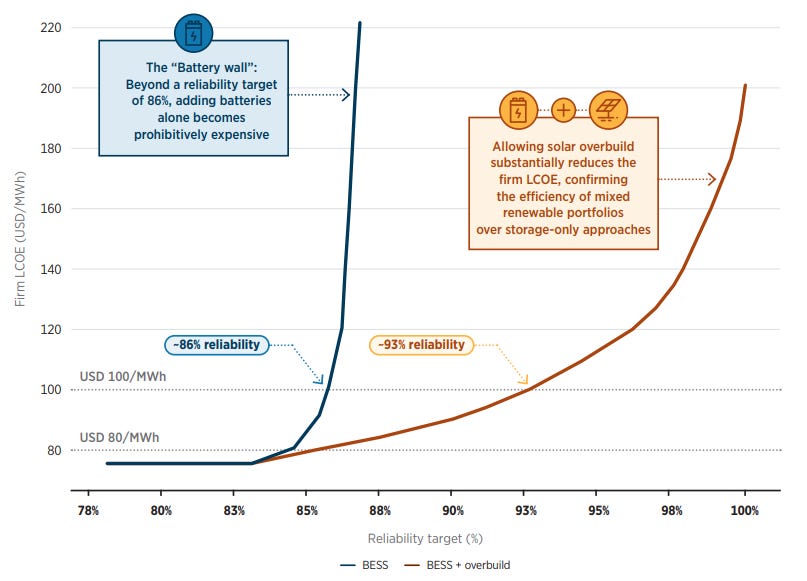
IRENA’s 2026 report on 24/7 renewables makes a claim that goes further than most: solar and wind paired with battery storage are now cost-competitive with fossil fuels, even when you need power around the clock. Not just during the day. Not just when the wind blows. All the time.
The framework they use is called “firm cost,” which prices in storage from the start so the comparison actually reflects what it costs to deliver power on demand. The numbers: firm solar-plus-storage now ranges from $54 to $82 per MWh in high-resource regions, against over $100/MWh for new gas globally and $70 to $85/MWh for new coal in China. Since 2010, solar PV costs have dropped 87%, onshore wind 55%, and battery storage 93%. IRENA projects a further 30% cost reduction by 2030 and 40% by 2035.
Why is this renewable energy cost report coming out now?
Because the debate has shifted, and IRENA knows it.
Russia’s invasion of Ukraine forced the EU to scramble for alternatives to Russian gas, ending up with the US supplying 58% of EU LNG in 2025. Add surging electricity demand from AI and data centres, and energy security has become the dominant political concern across the continent.
The result is a genuine nuclear revival across Europe. Poland is building its first nuclear plant. The UK reached final investment decision on Sizewell C in July 2025. In March 2026, European Commission President Ursula von der Leyen called turning away from nuclear “a strategic mistake for Europe.” IRENA’s report is, in part, a direct response to that momentum: before you pivot entirely, look at these numbers properly.
Is the criticism of wind and solar reliability costs fair?
Partly, yes. Professor Jan Emblemsvåg’s recent analysis argues that IRENA’s firm costs still undercount what a truly reliable renewables-based system costs at scale. His central example is the Dunkelflaute, a German term for extended periods of cold, still, overcast winter weather where both wind and solar can be effectively useless for days or weeks at a time. Batteries struggle to cover that kind of event. A multi-week, continent-wide shortfall is a fundamentally different challenge from shifting an evening peak. He is not wrong on the physics.
But here is where the comparison breaks down. IRENA is pricing a well-sited hybrid project in a good resource region. Emblemsvåg is pricing the cost of keeping the lights on across an entire continent during a worst-case multi-week weather event. These are not the same question. Treating them as if they are is exactly where most energy cost discussions go wrong.
What do battery storage costs actually look like in Europe today?
Ember’s October 2025 analysis, based on real auction data from Italy, Saudi Arabia, and India, puts utility-scale battery costs at $125/kWh outside China and the US. That breaks down to roughly $75/kWh for core battery equipment and $50/kWh for installation and grid connection. The levelised cost of storage has fallen to $65/MWh.
Because that cost applies only to the share of generation being stored and not all of it, shifting 50% of daytime solar to the evening adds just $33/MWh to the overall cost of that electricity. Against a global average solar price of $43/MWh in 2024, dispatchable solar-plus-storage comes to roughly $76/MWh. That is not a projection. That is today’s auction data from real projects.
It is worth being clear about what batteries are actually for here. In practice, modern grids do not rely on a single backup technology. The real toolkit is cross-border interconnectors, demand response, pumped hydro, green hydrogen, and firm dispatchable capacity working together. Batteries are excellent at shifting daily peaks. They are one tool among many, not a silver bullet, and no major grid operator is expecting batteries alone to solve seasonal shortfalls.
Three costs, three different stories
This is the part most energy debates skip entirely. Here is how all three numbers sit side by side:
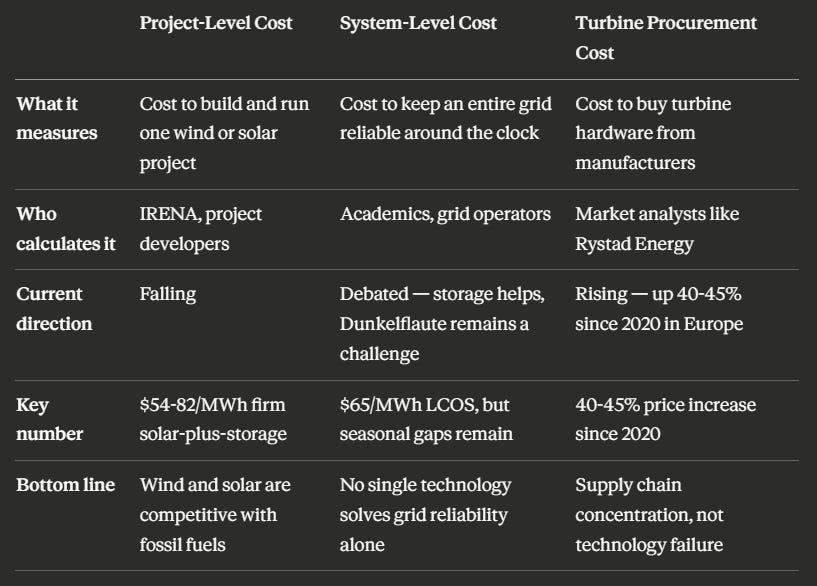
When someone tells you wind energy is getting cheaper, ask which column they are looking at.
So why are offshore wind turbine prices going up if renewables are getting cheaper?
Because project economics and turbine procurement costs are not the same thing. According to Rystad Energy, offshore wind turbine selling prices have risen roughly 40 to 45% since 2020 in Europe. Following technical setbacks at one major manufacturer, the European market is now effectively served by two dominant suppliers for nacelles and blades. Less competition means more pricing power.
This is a supply chain concentration problem, not a technology problem. But it is real, and it matters. The cost of wind energy is not one number. It is a project-level number, a system-level number, and a supply chain number, and they can all move in different directions simultaneously.
What is the right conclusion on wind energy costs?
Not “renewables win” and not “nuclear wins.” Both framings miss the point entirely.
The smartest actors in this space are not choosing sides. Tech companies scaling AI data centres are signing wind and solar PPAs while co-investing in nuclear restarts and Small Modular Reactors. China is simultaneously deploying the world’s largest renewables fleet and leading global nuclear construction. Nuclear capacity is likely to expand, and it should be part of the mix. The Bulletin of the Atomic Scientists noted in March 2026 that only France currently has the industrial capacity to build large-scale reactors at pace across Europe, which means it cannot be the whole answer on its own.
If it is windy, build turbines. If it is sunny, build solar. If you need low-carbon firm dispatchable power independent of weather conditions, build nuclear too. These are complements. The countries building all of it now will be in the best position in twenty years. The debate about which source is cheapest is worth having. Just not as a reason to wait.
If you enjoy this kind of writing and want to support it, you can buy me a coffee. It genuinely helps keep this going.
Frequently Asked Questions
What is a Dunkelflaute and why does it matter for wind energy?
Dunkelflaute is a German term for extended periods of cold, still, overcast winter weather where both wind and solar output can drop to near zero for days or weeks at a time. It is the main challenge for a grid relying heavily on variable renewables, and it is why battery storage alone is not sufficient. The real solution involves interconnectors, demand response, pumped hydro, and firm dispatchable capacity working together.
Why are offshore wind turbine prices rising in Europe in 2026?
Following technical setbacks at one major manufacturer, the European offshore wind market is now served by essentially two dominant suppliers for nacelles and blades. Less competition gives manufacturers more pricing power, pushing turbine selling prices up roughly 40-45% since 2020.
Should Europe build more wind farms or more nuclear plants?
Both. The countries making the most progress on energy security are not choosing between renewables and nuclear — they are building all of it simultaneously. China leads the world in both new renewables deployment and new nuclear construction. Tech companies financing AI data centres are signing wind and solar PPAs while also investing in nuclear restarts and Small Modular Reactors.
Disclaimer: All views expressed here are entirely my own and do not represent the views, positions, or opinions of my employer or any organisation I am professionally affiliated with.